

Can Direct Universal Credit Payments be Made to Landlords?
03-02-2026 | FinancialThere has been an identifiable shift in how rental income is managed with the transition of tenants being able to use universal credits to pay for rent. The Universal Credit system was created to encourage personal responsibility amongst tenants, as they are now responsible for paying landlords directly once the Department for Work and Pensions pays them. So, paying rent using Universal Credit now takes place as a direct payment to the landlord.
But there may be times when tenants struggle to budget and don’t pay landlords on time, which is why other measures have been put in place. This is especially useful if you use a system called Managed Payment to Landlord (MPTL), where the DWP pays the rent directly to you and bypasses the tenant. Here, we’ll discuss the official process for this and how you can secure your monthly rental income through a direct payment to landlords with a universal credit arrangement.
What is a managed payment to landlord (MPTL)?
As we have already discussed, an MPTL is an alternative arrangement, known as an Alternative Payment Arrangement (APA). Although this is not always the case, there is recognition by the DWP that some tenants may put their housing at risk by not fulfilling their rental obligations.
When this process is in place, the housing cost portion of the tenant’s Universal Credit amount is sent directly to the landlord’s bank account. The MPTL arrangement will be periodically reviewed because the long-term goal is for tenants to be able to manage their own finances.

When can landlords request direct payment?
The positive thing is that you don’t need to wait for permission from your tenant to request a direct payment as a landlord with Universal Credit. If specific triggers are met, then you’re within your rights to request this.
There are certain triggers that you should look out for when considering direct Universal Credit payments being made to you as the landlord. These triggers are divided into two categories: arrears-based triggers and vulnerability-based triggers.
1. The arrears triggers
This is the most common trigger for landlords requesting direct payment with Universal Credit when managing rent debt.
- Two months of arrears: the DWP will, in most cases, grant direct payment when there is 8 weeks’ worth of rent arrears.
- Persistent underpayment: if your tenant has accrued rent arrears that are equal to one month’s rent over a longer period, you’re able to request direct payment.
2. Tier 1 and Tier 2 vulnerability factors
There doesn’t necessarily need to be rent arrears for you to be able to request direct payments with universal credits as a landlord. If a tenant meets either the Tier 1 or Tier 2 vulnerability criteria, you are within your rights to request direct payment.
Tier 1 factors (high priority):
- Addiction: Drug, alcohol, or gambling dependencies.
- Mental health: Documented mental health conditions that affect financial management.
- Learning disabilities: Literacy or numeracy challenges.
- Homelessness: If the tenant was recently homeless or is in temporary/supported accommodation.
- Domestic abuse: Cases where financial control is a factor in safety.
Tier 2 Factors (lower priority):
- No bank account.
- History of rent arrears (even if currently clear).
- Refugee or asylum seeker status.
- Leaving prison or hospital within the last 3 months.

How landlords can apply for direct payment using Universal Credits
The process of a landlord applying for direct payment using Universal Credit has become increasingly digital, and the method of your choice will depend on whether or not you are a private landlord or a social housing provider.
For private landlords
If you are a private landlord, you should use the official service on GOV.UK, which replaces the manual UC47 process. You will need specific details for this, for example:
- Tenant details: Full name, address, and date of birth.
- Claim details: The tenant’s National Insurance number (if known).
- Evidence: A copy of the tenancy agreement and a current rent statement showing the arrears.
- Bank details: You will need to provide your bank information so the DWP can set up the transfer.
For social landlords (the landlord portal)
Most housing associations and social providers have access to the Universal Credit Landlord Portal. If you have access to this service and you have ‘trusted partner’ status, you’ll be able to verify housing costs and can request MPTLs directly through the portal. As you can imagine, this is a lot quicker than applying through the manual route.
It is important to note that, even though the DWS prefers to have the consent of your tenants, they do not legally require it if your tenant has hit the two-month threshold. It will be up to the DWS to then notify the tenant, giving them a chance to provide evidence if they disagree with the rent arrears amount.
Recovering rent arrears
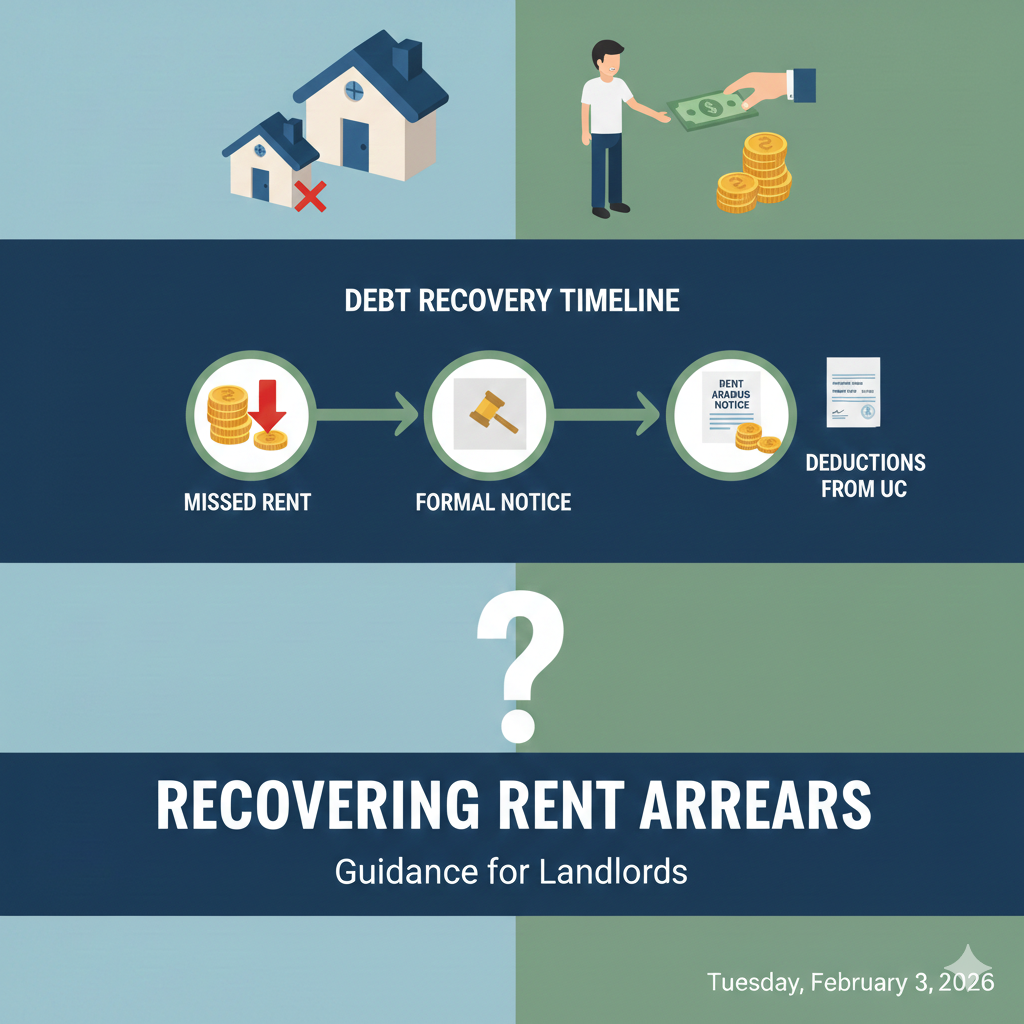
One important aspect of an MPTL is that it only covers the ongoing monthly rent amount and will not cover the amount in arrears. There are specific ways that you can recover the amount owed to you, though, specifically through Third-Party Deductions (Rent Arrears Deductions).
The DWP is able to deduct a fixed percentage from the tenant’s allowance in order to pay off the rent arrears. There is a standard deduction rate, known as the Fair Deduction Rate, that is implemented to ensure that the tenant isn’t left unable to survive.
These payments are typically made to landlords every four weeks, and it can take up to six weeks for the payment to arrive once the application has been processed.
Common pitfalls
There are a few things to keep in mind when direct Universal Credit payments are made to landlords, for example:
1. The five-week wait
The main thing to remember is that universal credit is always paid in arrears, and so when the claim is first made, there is a mandatory five-week waiting period. So, if you apply for an MPTL at the start of the claim, your first payment will arrive in at least five weeks.
2. The benefit cap and LHA shortfalls
The DWP will only pay according to the housing element of the tenant’s Universal Credit. If, for example, the rent amount exceeds the Local Housing Allowance (LHA), the DWS will only cover the portion that falls under it, and the MPTL would not cover the full amount. So, you will still need to collect the difference from the tenant directly.
3. Payment timings
You will also need to keep in mind that any direct Universal Credit payments you receive as a landlord will be made on the date the tenants first claimed. So, if, for example, your tenant claimed on the 10th of the month, you will only receive the rent arrears on this date, even if rent is due on the 1st of every month. This is important to keep in mind when budgeting and taking other expenses into account.
4. Overpayments
If you accidentally receive a payment from the DWS after the tenant has moved out, this will be considered a ‘recoverable overpayment’. The DWS then has the power to deduct this from other future MPTLs received from different tenants.
Securing a direct payment as a landlord in the form of universal credit is an effective way to manage risk in the UK rental market if you have tenants who pay using this system. It can protect your cash flow, as well as help vulnerable tenants manage their housing.
Are you looking for landlord insurance to protect your investment? Our team at CIA Landlords has the expertise to find the best quote for your needs.
Feel free to visit our advice centre for more advice on being an effective landlord. Otherwise, make sure to get in touch with our friendly team of specialists at CIA Landlord Insurance on 01788 818 670.
Landlord Insurance from £11.97 per month*
Get a quote